

Recently, I charged one of my clients $300 to optimize the SEO of their WordPress website. They agreed without hesitation because they wanted better rankings and more traffic.
After completing the optimization, they started seeing improvements within weeks. That’s why clients are willing to pay; they want results without learning everything themselves.
But here’s the truth most people don’t know. I use Rank Math SEO for almost the entire process, and it does most of the heavy lifting.
In this article, I’ll show you the exact workflow I use for paid clients. You can follow the same steps and do it yourself for free.
How I Started Offering Rank Math SEO as a Service

When I first started working with WordPress, I was only focused on improving my own website. I spent months learning SEO, testing different methods, and trying to understand how rankings actually work.
In the beginning, everything felt complicated and frustrating. I didn’t know what to optimize, and most SEO guides were too technical for me to follow properly.
Things became much easier after I started using Rank Math SEO. It showed me clear steps, fixed my mistakes, and helped me understand SEO in a practical way.
After seeing real improvements on my own website, I started helping others using the same process. Recently, I charged one of my clients $300 to optimize their website SEO, and they were happy to pay because they wanted better results.
What surprised me most was how simple the process had become. Rank Math simplified almost everything, and I was able to deliver professional SEO optimization without complicated tools.
Why Clients Pay Me $300 for Rank Math SEO

Most clients come to me because their website is not ranking and getting little or no traffic. Even though they publish content, their pages are not properly optimized, which limits their visibility.
Using Rank Math SEO, I fix their SEO issues and fully optimize their website. Clients pay me $300 because I help turn their poorly optimized pages into search-engine-friendly content with real ranking potential.
Here are the most common problems I fix for clients:
Poor Google rankings
Low or zero organic traffic
Bad title and meta description optimization
Missing or incorrect keyword placement
No schema and technical SEO setup
Broken links and 404 errors
Low SEO score in Rank Math
Here’s the value I provide:
Complete on-page SEO optimization
Technical SEO setup using Rank Math
Improved SEO score and structure
Better visibility and ranking potential
Why I Chose Rank Math (Instead of Yoast or Others)
When I started offering SEO services, I tested several SEO plugins, including Yoast and other popular options. While they worked, I often felt limited because many important features were locked behind expensive plans or required additional plugins.
Everything changed when I started using Rank Math SEO. It provided advanced SEO features in one place, simplified the entire optimization process, and helped me deliver professional results for my clients without extra tools.
Rank Math
- Content AI Integration
- Built-in Schema Generator
- Multiple Keyword Optimization (Free)
- Advanced SEO Score and Suggestions
- Keyword Rank Tracker
- 404 Monitor and Redirection Manager
- Instant Indexing Support
- Built-in Analytics Integration
Other SEO Plugin
- Not Available
- With Their Pro Plan
- Single Keyword Optimization
- Only Suggestion Available
- Not Available
- 404 Monitor Available
- Not Available
- Not Available
My Exact $300 Rank Math SEO Workflow (Core Section)
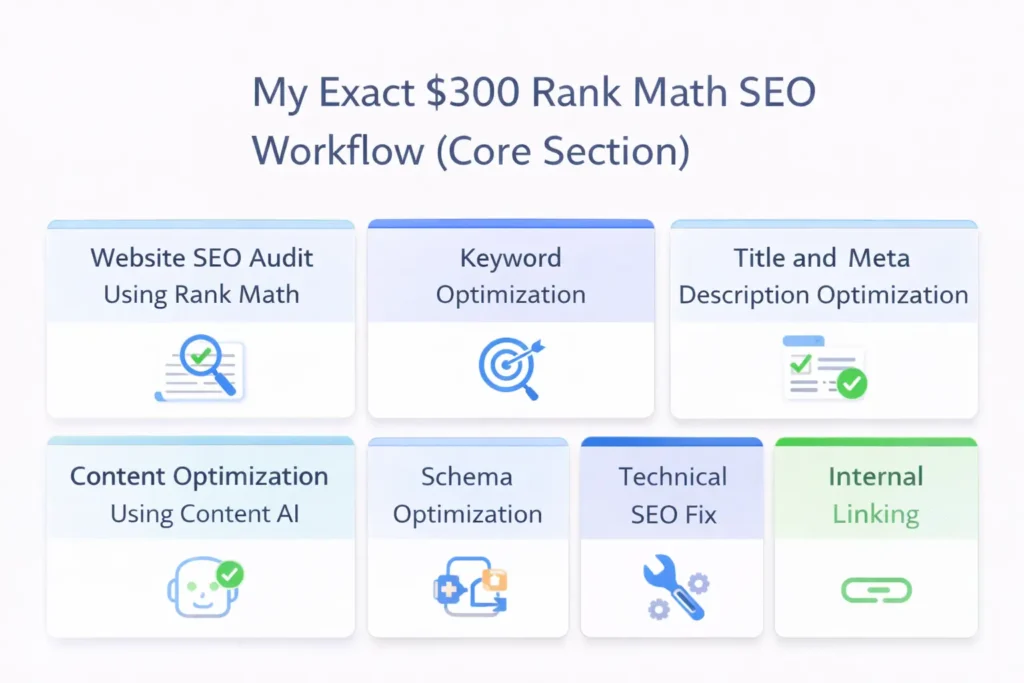
This is the exact workflow I use when clients pay me $300 for SEO optimization. I follow the same proven process every time because it helps me optimize websites properly and deliver real results.
The best part is, this entire workflow is powered by Rank Math SEO, which makes the process simple and effective. Below, I’ll show you the step-by-step system I use for clients, and you can follow the same steps for free on your own website.
Step 1 – Website SEO Audit Using SEMrush
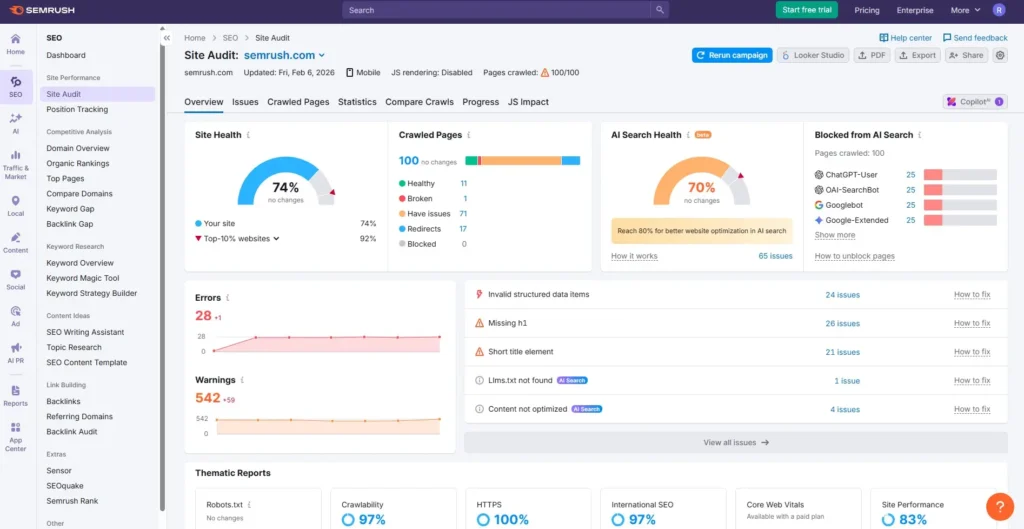
Before optimizing the website with Rank Math SEO, the first thing I do is perform a full SEO audit using SEMrush. This helps me identify all the hidden SEO issues that are stopping the website from ranking.
As you can see in the screenshot, SEMrush shows the Site Health score is 74%, which means the website has several issues that need fixing. It also shows 28 errors and 542 warnings, which clearly indicates why the website is not performing well in search results.
Another important section is the Crawled Pages report, where SEMrush found that most pages have issues, including broken elements and redirect problems. These technical problems can prevent Google from properly crawling and ranking the website.
SEMrush also detected critical SEO issues like:
Missing H1 tags
Short title elements
Invalid structured data
Unoptimized content
Technical SEO errors
This audit gives me a complete roadmap of what needs to be fixed. After identifying these problems, I use Rank Math to fix them step by step and improve the overall SEO performance.
Step 2 – Keyword Optimization
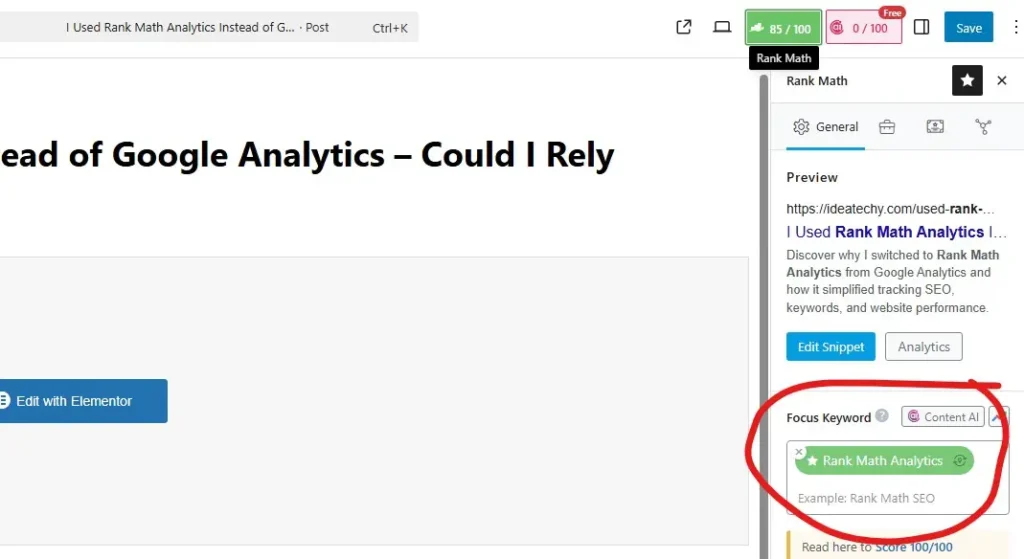
After completing the SEO audit, the next step is keyword optimization using Rank Math SEO. This is one of the most important steps because proper keyword placement helps Google understand what the page is about.
First, I select the main focus keyword based on the client’s niche and search intent. Then, I add that keyword inside Rank Math’s focus keyword field so it can guide the optimization process.
Rank Math helps me optimize the keyword in the right places, including:
SEO Title
Meta Description
URL (Permalink)
First paragraph of the content
Headings (H1, H2, H3)
Image ALT text
I also add secondary keywords and variations to increase ranking opportunities. My goal is to achieve at least a 80+ SEO score in Rank Math, which ensures the page is properly optimized.
This step alone significantly improves the page’s visibility and increases its chances of ranking on Google.
Step 3 – Title and Meta Description Optimization
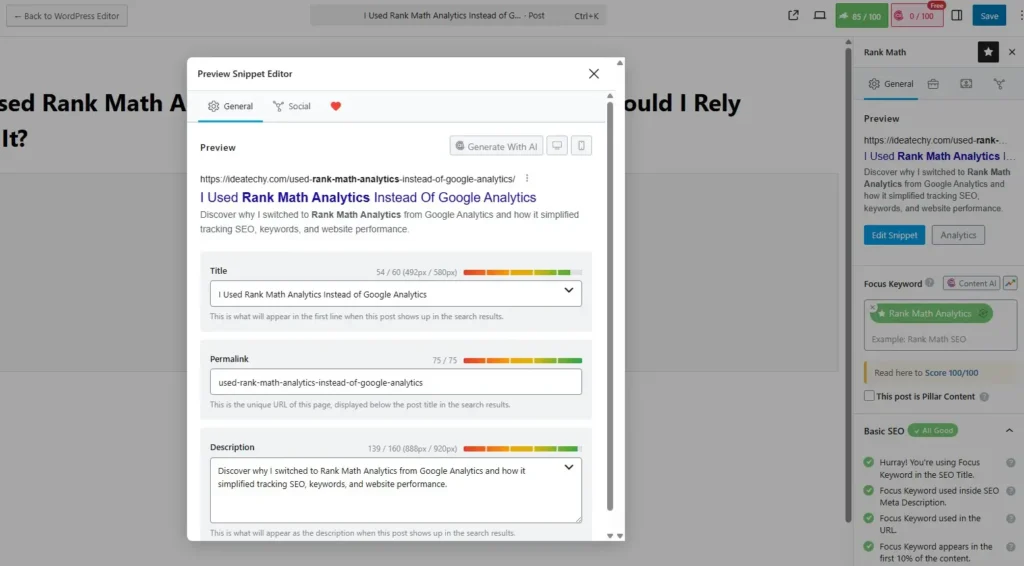
After optimizing the keyword, the next step is optimizing the SEO title and meta description using Rank Math SEO. This step is very important because the title and description directly affect your Google ranking and click-through rate.
First, I write an SEO title that includes the focus keyword naturally and stays within the recommended length. Rank Math shows a preview and score, which helps me create a title that is both SEO-friendly and attractive to users.
Then, I optimize the meta description to clearly explain what the page is about. Rank Math guides me to include the keyword, keep the correct length, and make it more clickable.
Here’s what I make sure to optimize:
Add the focus keyword in the SEO title
Keep the title length between 50–60 characters
Write a clear and keyword-optimized meta description
Keep the meta description between 140–160 characters
Use action words to improve CTR
Check the Google preview inside Rank Math
This helps improve both ranking and traffic, which is one of the main reasons clients pay for this optimization.
Step 4 – Content Optimization Using Content AI
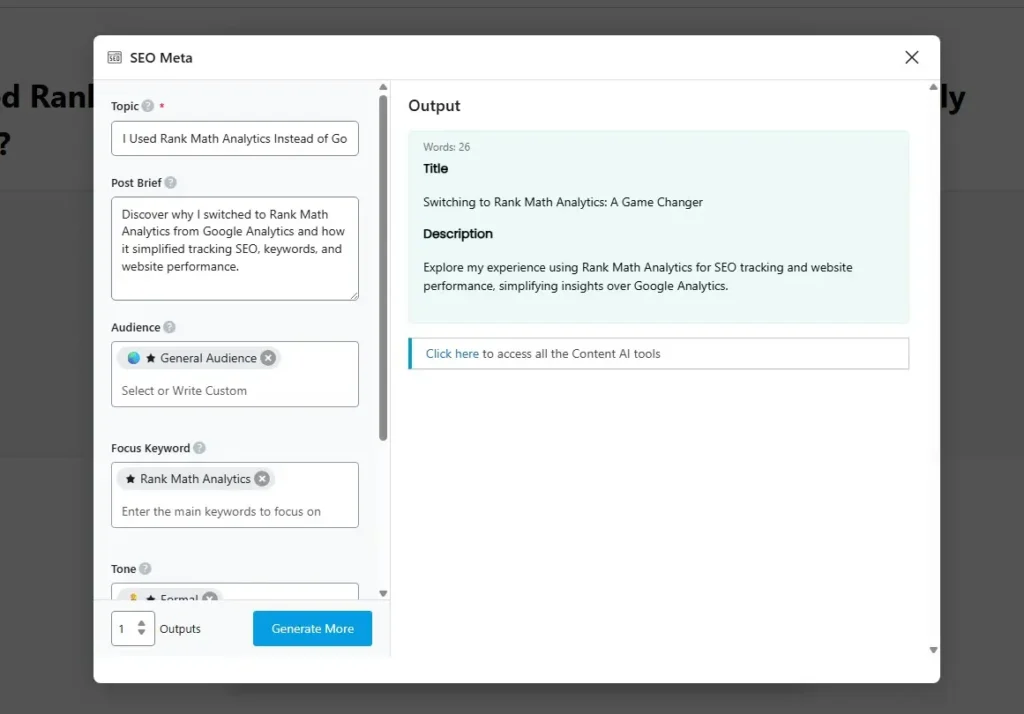
After completing the basic optimization, I use Rank Math SEO Content AI to improve the content quality and SEO performance. This feature helps me optimize the article based on real keyword data and search intent.
As shown in the screenshot, Content AI helps me generate an SEO-optimized title and meta description based on the focus keyword. This makes the content more relevant and improves its chances of ranking higher on Google.
Content AI also helps me improve these key areas:
Writing SEO-friendly titles and descriptions
Optimizing keyword placement naturally
Improving content clarity and relevance
Covering important topics related to the keyword
Increasing the overall SEO score
This step is very powerful because it ensures the content is fully optimized and competitive, which is one of the main reasons clients pay for this service.
Step 5 – Schema Optimization
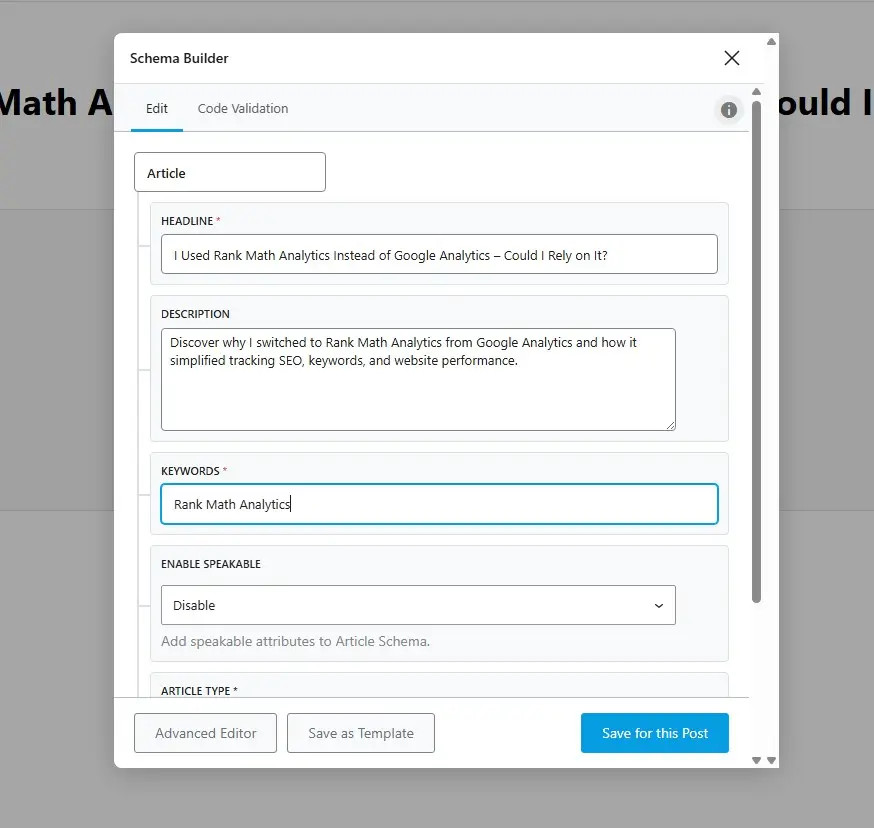
After optimizing the content, the next step is schema optimization using Rank Math SEO Schema Builder. This step is very important because schema helps search engines clearly understand the content and its purpose.
As you can see in the screenshot, I selected the Article schema and added the proper headline, description, and main keyword. This structured data gives Google more detailed information about the page, which improves indexing and increases the chances of better rankings.
Schema optimization also helps make the page more SEO-friendly from a technical perspective. It strengthens the overall optimization and ensures the content follows modern SEO standards, which is one of the main reasons this workflow delivers professional-level results.
Step 6 – Technical SEO Fix

After completing schema optimization, the next step is fixing technical SEO issues using Rank Math SEO. This step is important because technical problems can prevent a website from ranking, even if the content is well optimized.
I use Rank Math to identify and fix common issues like broken links, 404 errors, and indexing problems. I also make sure the sitemap is enabled, search engines can crawl the website properly, and all important pages are indexed.
Fixing these technical issues improves the overall health of the website and makes it easier for Google to trust and rank the content. This step ensures the website is fully optimized and ready to perform better in search results.
Step 7 – Internal Linking & External Linking

After fixing the technical SEO, the next step is adding proper internal and external links using Rank Math SEO. This step helps search engines understand the relationship between pages and improves overall SEO strength.
First, I add internal links to other relevant pages on the same website. This helps distribute SEO value across the site and keeps visitors engaged longer. Rank Math’s Link Counter helps me track internal links and ensure every important page is properly connected.
Then, I add external links to trusted and relevant websites. This improves content credibility and helps search engines trust the page more. Proper linking makes the content more complete and gives it a higher chance of ranking on Google.
Results My Clients Get After Rank Math Optimization
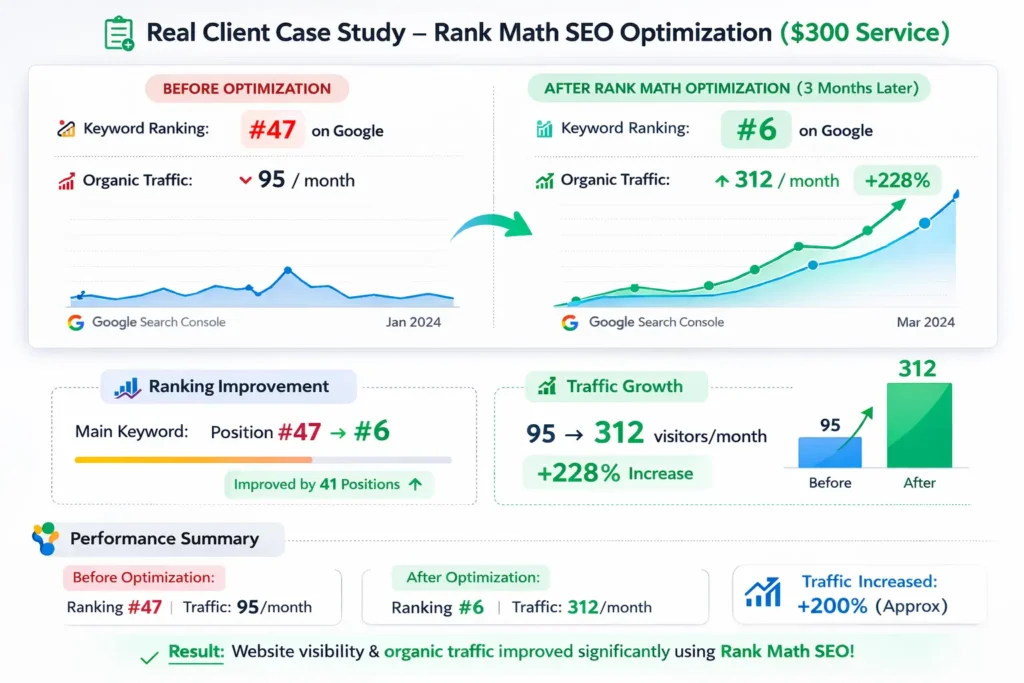
To show the real value of my $300 SEO service, here is one of my recent client results after optimizing their website using Rank Math SEO.
Before Optimization
Before I started, the client’s website was poorly optimized and struggling to get visibility. Their main keyword was ranking around position #47, which meant almost no traffic.
The website was getting only 95 organic visitors per month, and most of their posts were missing proper keyword optimization, schema, and internal linking.
After Rank Math Optimization
After completing my full Rank Math workflow, the results started improving within weeks. In about 3 months, their main keyword moved from position #47 to position #6 on Google.
Their organic traffic increased from 95 visitors per month to 312 visitors per month.
That’s an increase of 228% in organic traffic.
Ranking and Traffic Improvement Summary
Before Optimization:
Keyword Ranking: #47
Organic Traffic: 95/month
After Optimization:
Keyword Ranking: #6
Organic Traffic: 312/month
Traffic Growth: +228%
This is why clients are happy to pay $300 for Rank Math SEO optimization. The process is simple, but the results can completely transform a website’s performance.
How Rank Math Makes This Process Easy
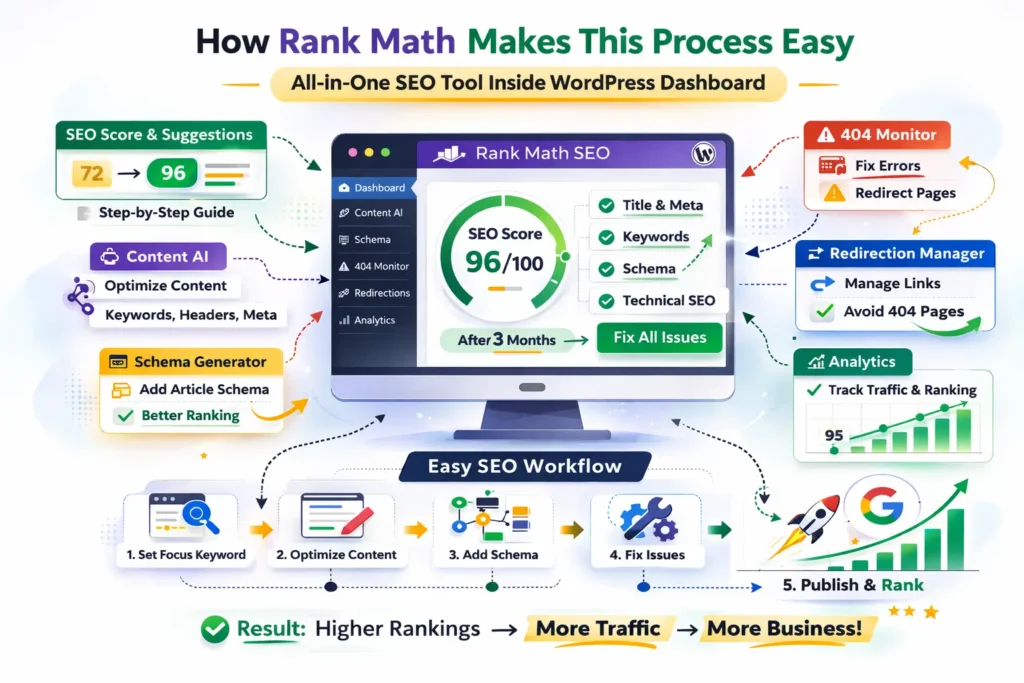
The main reason I can charge $300 for SEO optimization is because Rank Math SEO simplifies the entire process. Instead of using multiple tools and complex methods, Rank Math gives everything in one place inside the WordPress dashboard.
When I start optimizing a website, Rank Math shows a clear SEO score and tells me exactly what needs to be fixed. I don’t need to guess anything. It guides me step-by-step to improve the title, meta description, keyword placement, and technical SEO.
Rank Math also automates many advanced tasks that normally require expert knowledge. Features like Content AI, schema generator, 404 monitor, redirection manager, and built-in analytics help me optimize websites faster and more accurately.
Because of this, the process becomes simple, beginner-friendly, and highly effective. This is why Rank Math allows me to deliver professional-level SEO results — and the same process can be followed by anyone for free.
How Beginners Can Do This Same Process for FREE
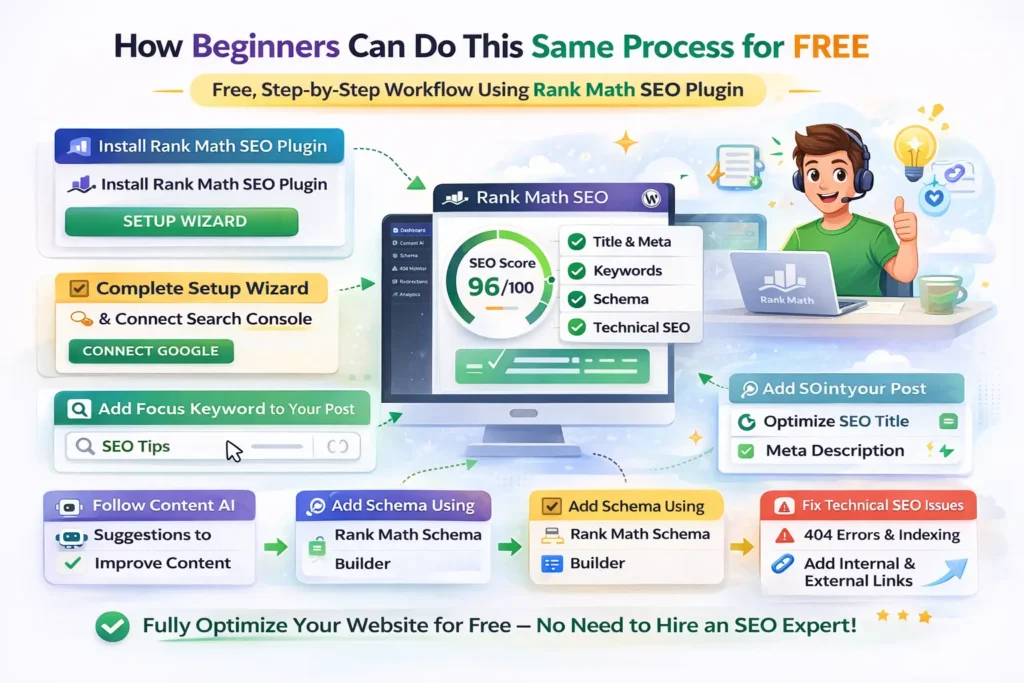
The best part about this entire workflow is that beginners can do the same process without paying $300 to anyone. You don’t need to be an SEO expert because Rank Math SEO guides you step-by-step inside your WordPress dashboard.
When I started, I was also a beginner and had no advanced SEO knowledge. I simply followed Rank Math’s suggestions, improved my SEO score, and fixed the issues it showed me.
Here is the exact process beginners can follow for free:
Install the Rank Math SEO plugin on your WordPress website
Complete the setup wizard and connect Search Console
Add your focus keyword to your post
Optimize the SEO title and meta description
Follow Content AI suggestions to improve content
Add schema using Rank Math Schema Builder
Fix technical SEO issues like 404 errors and indexing
Add internal and external links
If you follow these same steps, you can fully optimize your website without hiring an SEO expert. This is the exact same process I use for clients who pay me $300.
How You Can Start Your Own Rank Math SEO Service

Starting your own SEO service using Rank Math SEO is much easier than most people think. You don’t need years of experience because Rank Math already provides a complete optimization checklist you can follow.
The first step is to practice on your own website. Install Rank Math, optimize your posts, and learn how to improve your SEO score, fix technical issues, and use Content AI. This will help you build confidence and understand the real workflow.
Once you understand the process, you can start offering SEO as a service. Many website owners know SEO is important, but they don’t know how to do it properly, which creates a huge opportunity.
Here’s how you can start:
Optimize your own website and document the results
Create a simple SEO service package
Show before and after proof
Offer your service on Facebook groups, Fiverr, or Upwork
Start with a smaller price, like $50–$100
Increase your price as you gain experience
With the right workflow and Rank Math, you can turn this into a reliable income source, just like I did charging $300 per client.
Final Thoughts (Conclusion)
Charging $300 for SEO optimization might sound complex, but the truth is the process becomes simple with the right tool. Rank Math SEO makes it possible to handle professional-level SEO without needing advanced technical skills.
Everything I shared in this article is the exact same workflow I use for paying clients. From SEO audit to keyword optimization, content improvement, schema, and technical fixes, Rank Math helps manage everything step by step.
The biggest lesson I learned is that SEO is not about secrets, but about following the right checklist consistently. When your content is properly optimized and technically sound, ranking improvements naturally follow.
If you are a beginner, you can use this same process to grow your own website. And if you want, you can even turn it into a service and start charging clients, just like I do.